Tree pruning · Crown thinning
Crown thinning in County Durham
Make a dense tree lighter without changing its size. We take out selected branches from inside the crown so more light and wind get through, and the outline stays as it is.
NPTC qualified · Fully insured · Free in-person quotes
You don’t need to know the trade name. Just tell us what you want to change.
Send photos of your tree on WhatsApp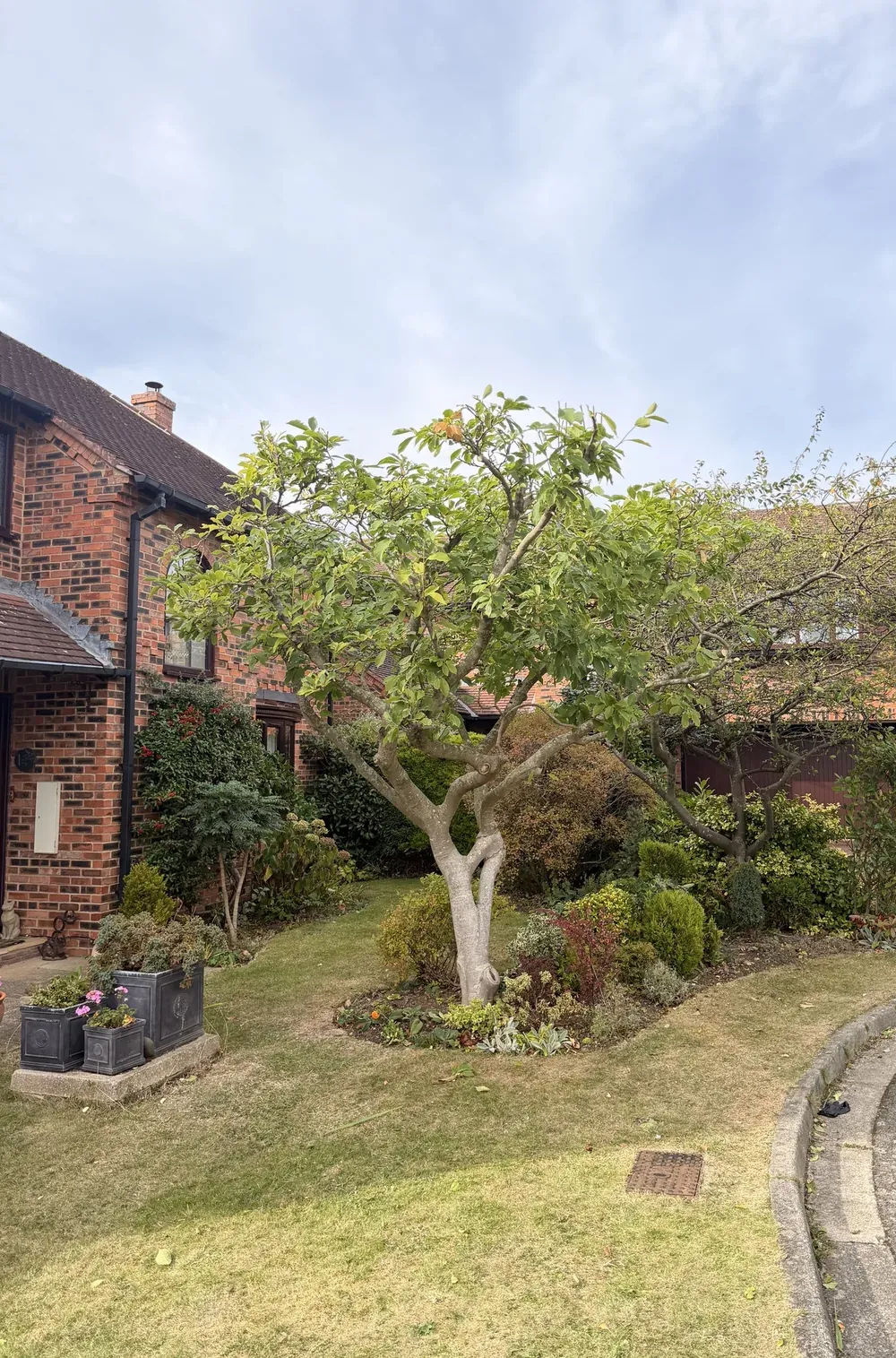
What crown thinning is
Fewer branches inside, the same outline outside
Thinning takes out a share of the smaller branches from inside the crown, spread evenly through the tree. Crossing and rubbing branches, weak shoots and crowded growth come out first. The tree is the same height and width afterwards; it is just less dense.
It is a quiet job when it is done well. People walking past may not notice anything, except that the tree looks lighter and lets more sky through.
Done badly, with everything stripped from the inside and only tufts left at the branch ends, a tree looks like a row of lion’s tails and is more likely to break in the wind. We thin evenly and keep the inner growth that holds the tree together.
Is it the right job?
When thinning helps, and when it won’t
Thinning suits a tree that is the right size but too heavy. It won’t make a tree any smaller, so it is the wrong job for a tree that has outgrown its space.
Usually a good fit
- The tree is a good size, but so dense that the garden underneath is dark and little grows.
- A heavy, full crown catches the wind, and you’d like to lighten it without making it smaller.
- Branches inside the crown are crossing, rubbing or crowding each other.
- You would like dappled light on a lawn or patio rather than deep shade.
Probably not the right job
- The tree is too big. Thinning doesn’t make it any smaller; a crown reduction does.
- You need one window or roof out of the shade. Cutting back the branches in the way usually does more.
- You need room underneath. That is a crown lift.
- An old or struggling tree that needs every leaf it has. Taking out only the dead wood may be kinder.
Thinning softens shade; it doesn’t remove it. A big tree on the south side of a garden still shades it after thinning, just more lightly and with patches of sun coming through. We’ll tell you honestly how much difference to expect.
Our work
A dense crown opened up
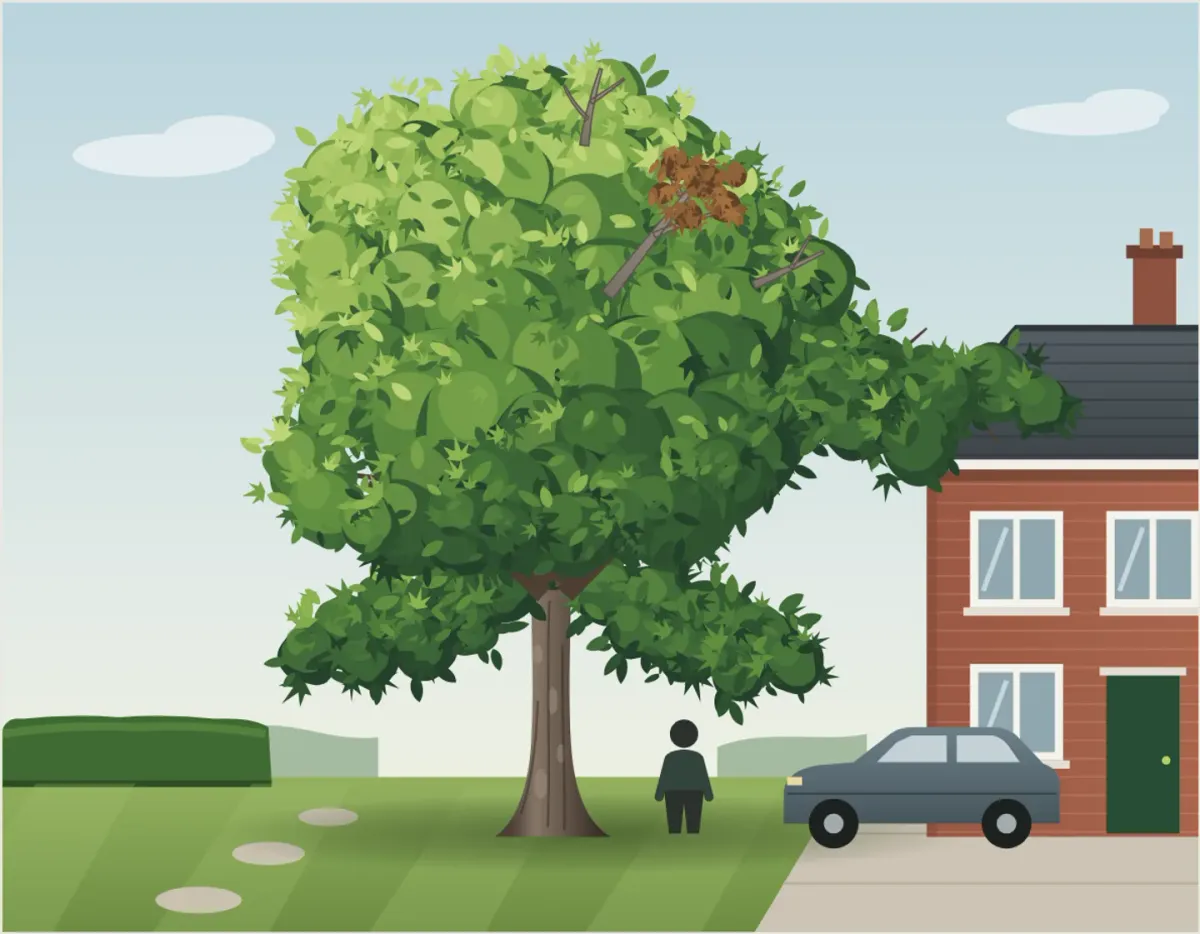
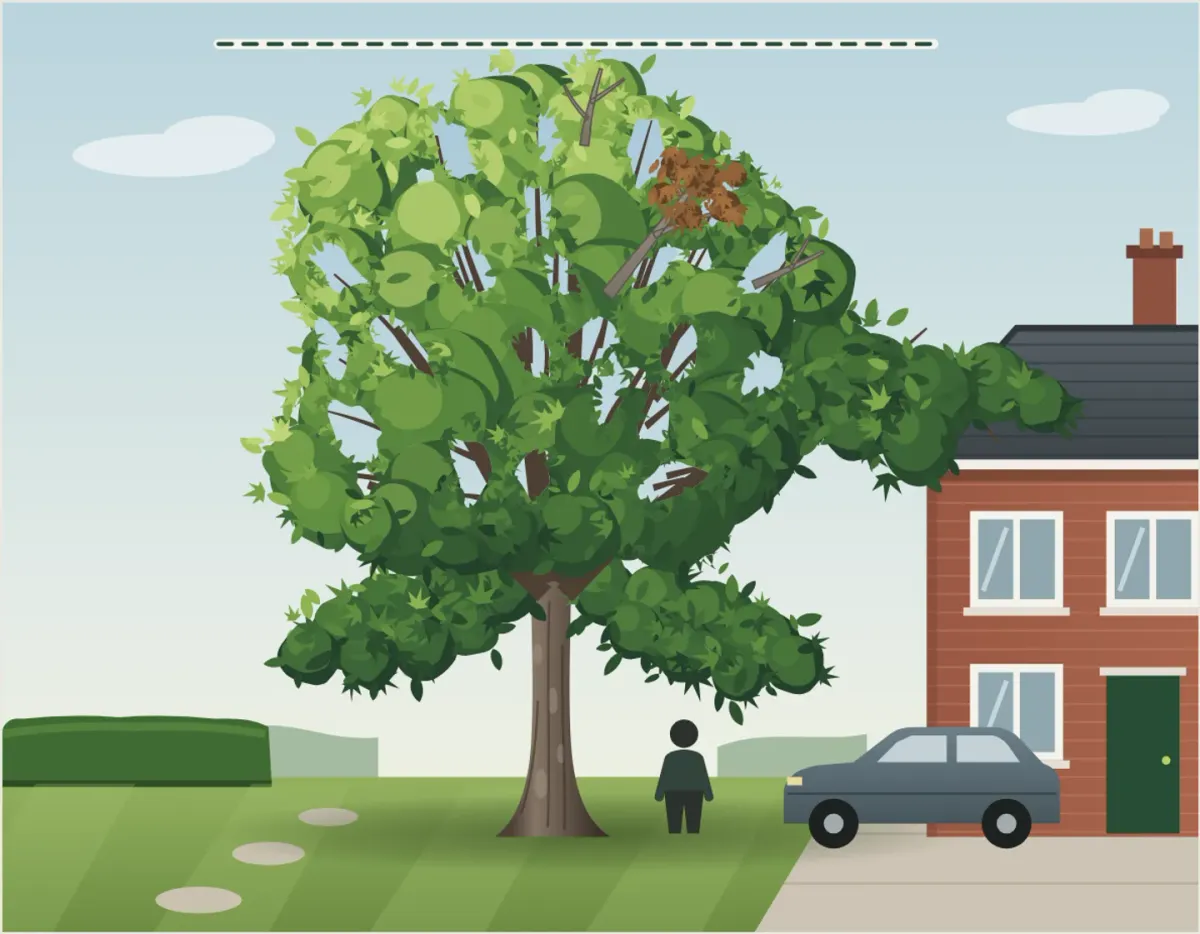
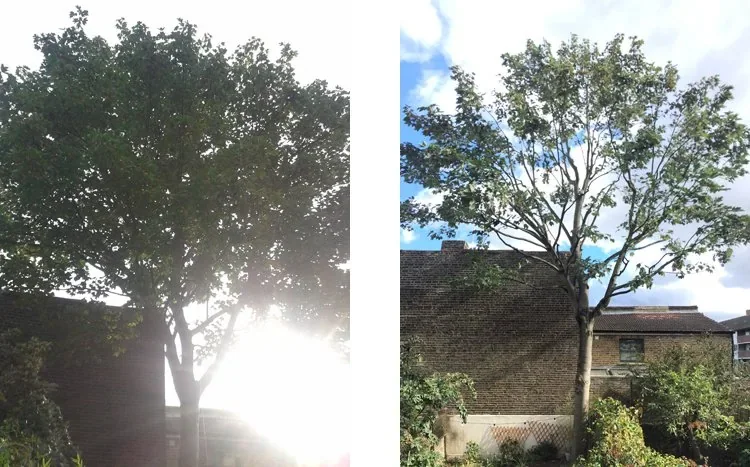
The same tree before and after our crown work. In the first photo the crown is a dark, solid mass against the light. In the second you can see the main branches, and far more sky through the crown, while its height and shape are much the same.
The Sedgefield tree at the top of this page is another example: the before and after photos show the full canopy and the same tree pruned, with its framework kept.
Afterwards
What the tree looks like when we’ve finished
Straight away, the crown is lighter and more see-through, and the same size. Light reaches the ground in patches rather than not at all.
Thinning shows most in summer. In winter, with the leaves off, a thinned tree looks much as it did before, with fewer twigs.
Over the next few years the tree slowly fills the gaps again; how quickly depends on the species. We’ll tell you when it is worth looking at again.
Timing and permission
When to book, and what to check first
Thinning can be done at most times of year, with a few exceptions.
- 01
Leaves on or off
In summer it is easier to judge how dense the crown is and where the light falls. In winter the branch structure is clearer. Cherries and plums are best done in summer because of silver leaf disease, and birch and maple not in late winter, when they bleed sap.
- 02
Birds in a dense crown
A thick crown is exactly where birds like to nest. Between March and August we check carefully first, and an active nest is left alone until the young have flown, because nesting birds are protected by law.
- 03
Protected trees
Thinning a tree with a Tree Preservation Order needs the council’s consent, and in a conservation area you give six weeks’ notice, the same as any other pruning. The council will want to know how much is coming out. Our protected tree check finds your council from your postcode.
On the day
What you’ll see while we work
Most of the cutting happens inside the crown, so there is less to watch than with a reduction.
Ask about your treeWe agree how much comes out
Before anyone climbs, we go over the work with you on the spot, and where the branches and chippings are going.
A climber works through the crown
Most cuts are small and inside the tree, so a climber on ropes works through it branch by branch. From the ground you see a steady stream of small branches coming down.
You can see how it’s looking
Thinning can be hard to judge while it is happening. If you want to see the crown from the garden before we finish, in case you would like a little more out in one place, just ask.
We tidy up
Branches are chipped or taken away, depending on what is in your quote, and the area under the tree is cleared as agreed.
Other crown work
Not quite what your tree needs?
Thinning is often combined with a reduction or a crown lift. If you are not sure which your tree needs, tell us what bothers you about it.
- Crown reductionA smaller tree that keeps its natural shape.
- Crown liftingHeadroom over a path, drive, lawn or road.
- Deadwood removalDead and broken branches out before they fall.
- PollardingCut back to the same knuckles every few years.
- All tree pruningEvery kind of work side by side, with our pruning jobs.
Useful answers
Before you get in touch
How much of the crown do you take out when thinning?
Usually a modest share, spread evenly through the tree, rather than a lot from one place. Taking too much at once makes the tree throw out masses of new shoots and can leave it weaker. We’ll tell you what that tree can take after we’ve looked at it.
Will thinning stop leaves falling in my garden?
No. A thinned tree has fewer leaves, but it still drops them in autumn. If leaves in the gutters are the problem, cutting back the branches over the roof usually helps more.
Is crown thinning the same as crown cleaning?
Not quite. Crown cleaning means taking out dead, broken and diseased wood, crossing branches and old stubs. It is usually done as part of a thin, and on its own it is close to what we call deadwood removal.
Will thinning make my tree safer in the wind?
It can help a heavy, dense crown by letting the wind through rather than catching it. It won’t fix a split, a weak fork or decay in the trunk. If you’ve seen cracks, fungus or a change in lean, tell us when you get in touch so we can look at those first.
Can you thin a tree that has been topped before?
Often, yes, and it helps. A topped tree grows clusters of upright shoots from each old cut. Thinning those out and keeping the strongest, best-placed ones gives the tree a better structure over a few years. It usually takes more than one visit.
Will you need to see the tree before quoting?
For most tree work, yes. Thinning is about the inside of the crown, which a photo rarely shows well. Send a photo of the whole tree first and we’ll tell you whether thinning sounds like the right job, then come and look at it.
5.0 from 43 Google reviews
More reviewsRead the reviews on Google“Sharp Hedges came out today, they did a great job reducing our hedge and tidying it up.”
“Only a small garden job for my tree but the service by Sharp Hedges Tree and Garden Services was first class!”
“Excellent service. From the initial call to completing the job in less than a week.”
Ask about crown thinning
Tell us what the shade is doing
Send your postcode and tell us what the tree is doing that you’d like to change: shading the lawn, catching the wind, or just looking heavy. On WhatsApp, a photo of the whole tree and one looking up into the crown are ideal. We thin trees across County Durham and the North East.
What happens next
- 1We look at what you send.
- 2We clarify the job and, for most work, arrange a free visit.
- 3You get your quote, with no obligation.
We’ll look at the job details and reply between 8am and 8pm. If we need a closer look, we’ll arrange a suitable time with you.
Want to show us the job?